Thursday, 14 May 2015

Something in the way...


 Smells Like Teen Spirit

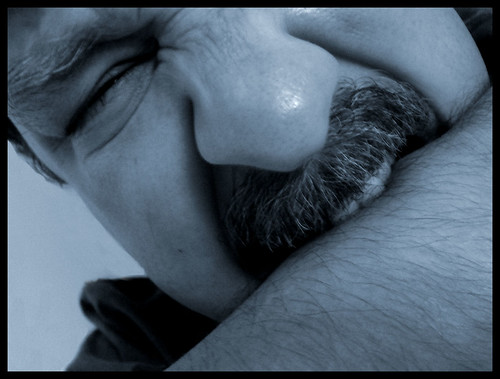
Nirvana's Kurt Cobain once famously sung a song called Something In The Way.  Like a number of his tracks, it was a bit of a barbed response to his own fans with whom he had something of a love/hate relationship.  The song highlights a rather sad character who has no coherent perspective on life and is living a drop-out hippy kind of lifestyle.  

The notion of 'something in the way' could be applied to displacement behaviour too.  In my view psychology is a bit too concerned with intra-psychic events (Freud's legacy) and not enough with environmental obstacles which affect mental health.  Very often people grow up in situations where natural behaviours are obstructed or blocked from being expressed.  It is the continued frustration of species specific behaviours at key points of development which can lead to brain re-wiring and maladaptive patterns developing.

For example, a parental figure who elicits both approach and withdraw behaviours can place a child in two minds, blocking the opportunity for secure attachment and creating a state of mind that requires a behaviour, such as hair pulling, in order to attain some measure of ease and comfort.  Dysfunctional environments can be a real problem for young kids because they are at an age where they are trying to adapt, rather than challenge the physical limits of their world.  Trying to make oneself fit a 'cage' that is not conducive to development can lead to all kinds of mental and emotional problems.

In this blog I contend that where normal behaviours lack the environmental basis for support or expression, the human brain develops its own strategies for achieving internal goal states, such as safety and comfort.  The brain, being the amazing thing it is, may be successful in achieving the desired psychological effects it seeks but at the cost of producing distorted behaviour patterns. Viewed from outside the context in which they develop these can appear to make no sense whatsoever and offer no obvious benefits.  Hair pulling is one such case in point.

So, maybe Kurt Cobain's song could have included another verse or two to reveal that a whole range of distortions can occur when something does get in the way of people being more adapted to the world. From psychology's perspective, these behaviours need to be judged from within the situation people find themselves and not solely from the outside if they are to be properly understood.  In other words, instead of seeing these behaviours as merely problems, they should also be viewed in terms of the compensatory benefits they provide in reaction to a repressive environment.

Sunday, 22 February 2015

Research update

Focusing on qualitative and quantitative methods is an area of study that interests me for a few reasons.  It links to my interest in academic research and academic language generally, but also to generating new methods for examing self-directed behaviours.

From hair pulling, to chin rubbing, thumb sucking, self-harming, scratching or non-pathological self-grooming...all these are things of interest because they link us to our evolutionary past.

Moments of indecision, the weighing up of costs and benefits, calculating pros and cons...such mental processes usually produce self-directed behaviours.  They help us to to navigate our way through the dilemna (do I turn left or right?, buy X or buy Y?, etc.) by soothing the anxiety caused by being in two minds.

In social situations other outward signs of mental processes where two conflicting impulses are in conflict can be seen.  Football fans regularly brush their hands through their hair after a near miss of the goal by their team's striker.  It is a commonplace event that occurs during every game, but apparently no one can explain it, except by saying it helps relieve tension, eases discomfort and restores equilibrium.

What makes these kinds of behaviours even more fascinating to me is that we share them with other animals.  More significantly animals in captivity display more self-directed behaviours than in the wild and hair pulling ONLY occurs in captive animals!

Displacement behaviours have a clear purpose it would seem.  They help us to navigate our way through short-term periods of anxiety by soothing us and limiting excitement until the internal conflict caused by the immediate environment has been resolved internally or until the external situation changes and the dilemna is over.

But sometimes people (and animals) can remain in anxious states for long periods and at key points in child development this can lead to unwanted behaviours emerging.  Imagine being caught in two minds about something not just for a few seconds but for hours, days or even years!

My approach would be to undertake research into what the possible benefits of these behavours are.  Do they reduce stress or the heart rate?  Do they affect metabolic rate?  What happens if these behaviours are prevented in some way so the discomfort of being in two minds is not relieved?  These are the kinds of questions I would like to answer.  

But devising experiments that are simple and give clear results is not easy...as any psychologist would probably testify to.  So, studying the different methods and approaches to doing research is very useful and also widely applicable!


Sunday, 11 January 2015

Environmental factors in hair pulling behaviour

Some lab animals develop behaviours like fur biting

It is extremely hard to tease apart enviromental factors in the hope of ascertaining root causes of things. (In fact, so much so scientists do not even try!)  But one area that seems really helpful to explore in relation to hair pulling (and perhaps other self-directed behaviours) are ongoing stressors that cannot be avoided.

Where self-directed behaviour has emerged in some animal studies there have been environmental stressors identified which the organims cannot switch off to nor regulate.  A good example is where parrot in cages were hung the length of a room.  Those nearest to the doorway, through which people were coming and going most frequently, showed greatest signs of disturbance, as manifested in feather plucking behaviour.

As far as I know, the same understanding of such an environmental issue has not been applied to hair pulling.  Are there continuous stressors that the child can neither avoid, nor alter, nor control in any way?  Stressors might include personal space being consistently disrespected, incestuous advances or consistent rejection.  

The point is that a schism emerges between a person and their environment.  Sensory discomfort can only be countered by somehow negating sensory stimulation by attempting to switch off the environment in question.  If this state of affairs persists for a period of time during a sensitive developmental period, re-wiring can emerge with self-directed behaviours being manifested.

In addition to parrots, the same kind of effects have been found in mice where who were closely related genetically (i.e. parents, siblings) and housed together.  This produced a situation whereby the  sexual behaviour of mice could only be enacted in a context of incestuousness.  Fur biting soon followed.

I think people who do have hair pulling problems may benefit from considering closely those aspects of their formative environments that compromised them emotionally or sexually.

Thursday, 20 November 2014

Hair pulling (trichotillomania) IS a displacement behaviour

image by Steve Doria
Categorising hair pulling behaviour seems to be something that psychologists struggle with.
Of course, no one can make strong assertions without evidence. But from people who do pull out hair and have an 'inside take' on the problem, phenomenological information can be obtained.

From speaking to people who pull their hair out certain common feelings seem to be apparent.  A rise in anxiety prior to pulling, a relaxation following the extraction and an automatic sequence that is repeated which seems to restore some sort equilibrium until the anxiety passes.

This is exactly what displacement behaviours exist for of course.  In nature, animals demonstrate displacment behaviours when they are caught between
two behaviours, such as fight or flight.  The displacement behaviour lasts until the situation changes and the organism is no longer experiencing a conflict of mutually exclusive tensions.

In our household pets self-biting is common among dogs who are distressed.  This self-directed behaviour seems to offer a classic view of what displacement behaviour is.  Such a poor animal's distress might take the following course.

1.  a need to escape a threatening situation - but no escape is possible!

2.  instead of escaping, avoidance is attempted - but there is no away to
     avoid the stressor either.

With two key survival strategies frustrated the animal can find no control over its environment. Whatever it does, it cannot solve the problem and find comfort or safety.  The self-directed behaviour emerges as a final act by which the dog can exercise some control over its physiological state.  Self-biting is a means of disengaging from its environment (i.e.from the source of its stress) via an action which achieves some measure of equilibrium but by maladaptive means.

I believe that hair pulling in humans serves the same effect. The hair puller's environment is causing stress that the person cannot escape or avoid or findany solution to.  In young developing people where the brain is still wiring itself, such pressures can lead to lifelong hair pulling because the child is not psychologically strong enough  to cope with its situation.  Once the behaviour begins it becomes part of the intrinsic behaviour pattern of the individual concerned  and is hard to break - but not impossible if the conditions in which the child was embedded at the time the disorder developed can be uncovered and the original anxiety identified and worked through.

To say there is a cure is a bit of a misnomer.  Hair pulling can be stopped, but the original anxiety that led to its emergence is something that can never be taken away.  But it can be faced and coped with, so that the adult hair puller does not have to be a prisoner of the childhood environment in which hair pulling served as the self-comfort of last resort.


Monday, 10 November 2014

Instinct - Hollywood on the effects of captivity

Instinct poster.jpgThere are not many movies that try to tackle truly big themes, such as why is civilisation so brutal and make a clear link between civilisation and life in captivity.  In this blog the idea of captivity is prominent because certain behaviours in animals emerge in captivity that do not appear in animals living wild.  And, for me, behaviours like hair pulling can be traced to environmental deprivation in both animals and humans.  So, it was a big thrill to watch a Hollywood movie that tries looks at how environments can undermine species specific behaviours and how these environments can turn people crazy.  

Dr. Ethan Powell (Anthony Hopkins) has been arrested and returned to the USA after committing a murder in Rwanda, where he has been living amongst a group of gorillas, who have accepted him as part of their family. He returns and appears violent and refuses to speak until a psychiatrist, played by Cuba Gooding, Jr takes on his case as a way of furthering his own career.  He hopes to maybe write a book based on this curious case.

In the high security section of the jail where Powell is kept with other 'psychotic' patients, there is a lot of brutality from the prison guards who have their own ways of keeping the prisoners in line. Due to staff and funding shortages only one prisoner is allowed out each day into the exercise yard.  They randomly award each inmate a card from a standard playing deck and the one holding the ace of diamonds gets to see the sun and sky whilst the rest have to stay inside.  However, in reality the same person gets to go outside each day because he is able to bully the ace out of anyone weaker than him...until Powell arrives.  He fights to keep his ace and establishes a new pecking order, which arouses the dislike of the senior guard.

Meantime, the psychiatrist has started to win Powell's trust and got him to slowly open up.  We begin to understand why he killed someone.  He was living in peace with the gorillas and they had accepted him - not as one of their own (i.e. a gorilla) - but as a member of another species they accepted into their ranks.  This, as the film points out, is an amazing act.  Eventually, soldiers come to find Powell who has been reported as missing.  They open fire and kill all the adult gorillas believing them a threat.  Desperate to protect them Powell attacks them and kills one.

Understanding his patient better, Gooding's character tries to get him out of prison but further fights break out and it looks as though Powell will never be let out. Powell also makes him understand how we all live in captivity and how all our behaviours are distorted by this because we lack control over our environment.  Powell, profoundly explains how civilisation is a form of trap because we can never get outside of it and how it rewards destructive behaviours such as hoarding and profit seeking.  

Towards the end Powell is able to escape captivity with the assistance of Gooding and some of the other prisoners and returns to life outside society in the African jungle.  Meanwhile, Gooding realises that his career path is all wrong and that his striving to reach the top means he can never truly be free from the objectives that civilisation set for him, but which he does not choose for himself.

Although there is no stereotypical behaviour featured in the movie it aims to get to the heart of why people and animal behaviour can become distorted by an environment that is not one that the organism evolved within and is an adaptation to. Hopkins and Gooding are great and carry the film, which could so easily have failed with a lesser cast.  So, well worth a look by anyone interested in behaviour and in need of some entertainment.


Monday, 8 September 2014

Caught In Two Minds - happy birthday!

image by Graceful Cake Creations
It is one year since I started this weekly blog on self-directed behaviours and 52 posts later and 2500+ hits on I would like to thank those of you who have visited or followed the site.

From talking about hair pulling, to chin rubbing, animal behaviour in captivity, hunter gatherers and evolutionary psychology - it has been a lot of fun discussing and sharing these topics.

The aim is to carry on with the blog, though in the future posts will be every 2-4 weeks rather than every week.  This is because of time and energy constraints in part, and the fact that it gets ever harder to cover new angles.

The purpose behind this blog has been to keep my interest in self-directed and displacement behaviours alive whilst I aimed at doing more research in the future.  However,  problems with funding have blocked this ambition unfortunately.  But maybe one day more work on hair pulling and other behaviours can be undertaken.

Thanks for visiting and don't forget to check the back catalogue to read some interesting articles on self-directed behaviours.

Will S.

Wednesday, 3 September 2014

Hair pulling as indicator of emotional dislocation

a dislocated elbow...but what about emotional dislocation?
 To me hair pulling behaviour points to a dislocation between an internal impulse (physiological) and its physical expression (behavioural) so that the impulse is constantly repressed or negated.  This ongoing tension may be compared to a rocking to and from between two states.  For example, a child will feel the need to approach a parental adult for comfort seeking needs, yet if this parent is unreliable and provokes a withdraw response the child is caught between two stools, so to speak.  If this situation is ongoing and no alternative adult is available the child will develop coping or maladaptive behaviours and hair pulling fits this category.  This is because hair pulling is a displacement behaviour, in my view, which emerges when two opposing impulses such as approach and withdraw are simultaneously activated.  The pulling is the nervous system's way of deactivating this short circuit and finding some resolution to the ongoing tension.

Hair pulling reveals that there is something wrong with the hair puller's environment.  They are unable to settle or feel at ease.  They may feel constantly agitated and hair pulling is a form of relaxation.  For example, they may not want to be alone and yet find themselves alone, desire to find some form of relief but unable to do so.  So, hair pulling is a form of homeostasis whereby physiological tensions that cannot be mediated through normal social avenues (e.g. approach behaviour) can find some outlet.

I have no direct evidence for this in human studies unfortunately.  This is the kind of research  I would like to do.  But animal studies where fur, feather and hair pulling have been noted do back up the idea, particularly in artificial or captive environments where species specific needs are not supported.  This means the animal is striving to attain some internal goal state but cannot achieve it through interaction with its sterile laboratory environment.  For example, it may lack materials to build a suitable nest or place of safety and so its attempts at doing so are constantly frustrated and aborted.  Body directed behaviour follows, whereby the animal's normal behaviour is shown to have been utterly derailed and its environment utterly unsuitable to allow its behaviour patterns to develop normally.

This line of enquiry is harder to prove with people but there are some key signals I would look for.  I would predict that some who pulls hair will be in a state of agitation or feel unsettled to some extent whereby they should be able to report some anxiety towards their environment either before or after the hair pulling episode. 

Too much therapy is focuses on the puller and not enough on its environment - by which I mean the environment in which the hair pulling first emerged.  This is the situation, along with the developmental needs of the person at the time pulling first took place, that needs closest analysis.  Too often we treat the symptoms rather than try to find underlying factors.